Make the criteria visible
Questionnaire items describe skills, experience, learning goals, and working styles, with each criterion marked for Similarity or Diversity.
Work
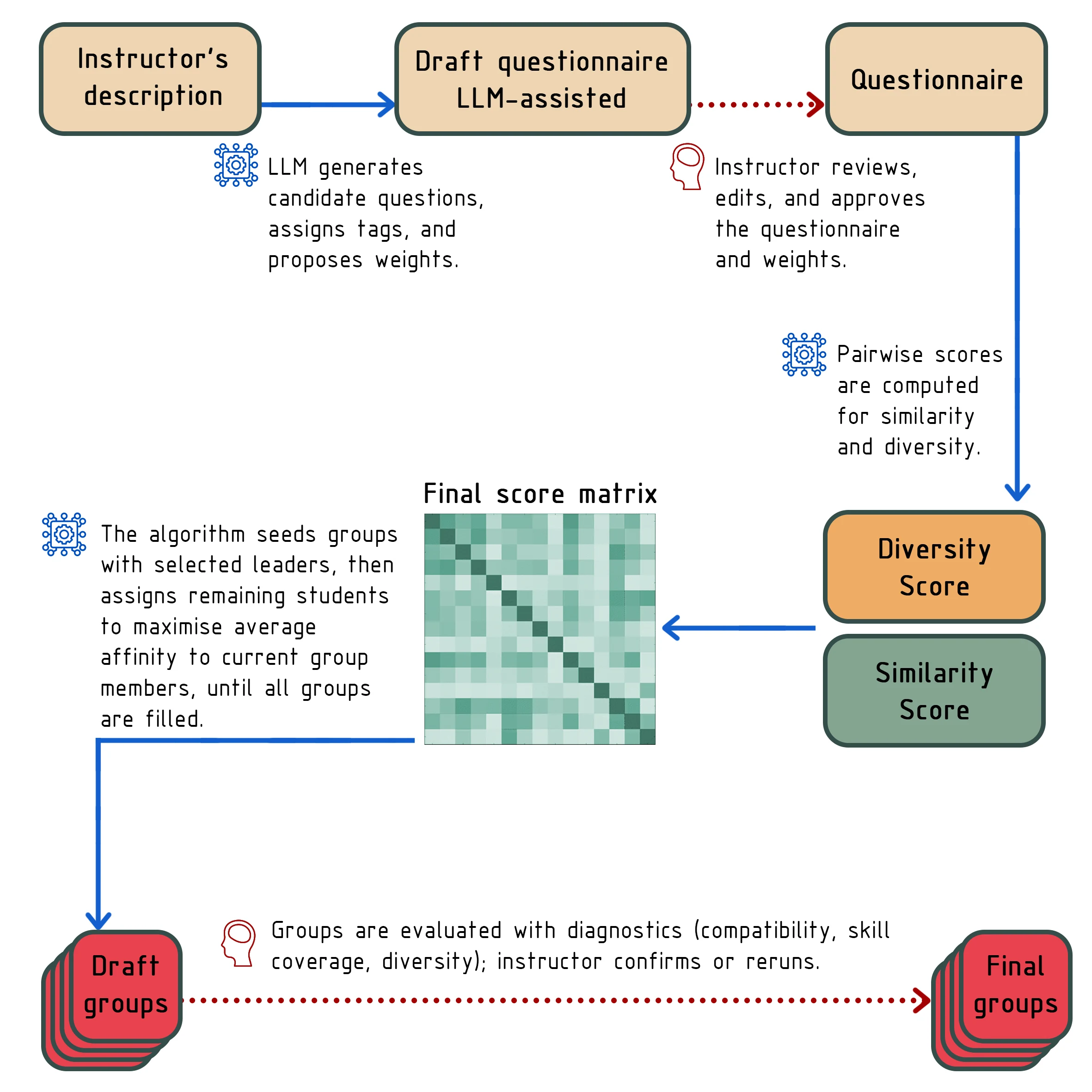
Transparent group formation workflow for a studio of 84 architecture students, combining questionnaire-based Similarity and Diversity scoring, Python assignment, instructor review, and an optional AI-assisted questionnaire extension.
Stage
The research develops a transparent workflow for forming groups in an 84-student architecture studio through questionnaire-based Similarity and Diversity scoring, Python assignment, and instructor review.
Questionnaire items describe skills, experience, learning goals, and working styles, with each criterion marked for Similarity or Diversity.
Python evaluates all 3,486 unique pairs, combines the scoring matrices with adjustable weights, and prepares a draft allocation under group-size constraints.
The workflow exposes its criteria, weights, and diagnostics so instructors can inspect and revise the result rather than accepting a black-box decision.
The method grew through teaching in 2024-2025 and 2025-2026 and became a conference paper scheduled for publication in 2026.
Backstage
I had to translate a teaching question into explicit criteria without pretending that the algorithm could replace instructor judgment or student agency.
Some criteria benefit from common ground while others benefit from complementary strengths. Keeping the matrices separate made those choices easier to inspect and adjust.
The script proposes groups and reports its reasoning. The instructor still checks the result, changes weights when necessary, and reruns the assignment.
All 84 students completed the final questionnaire. No transfer request was recorded apart from one administratively handled case, which kept the evaluation grounded in the actual studio.
The later OpenAI API extension suggests editable questionnaire items from a course brief. It does not assign students, and every suggestion remains under instructor review.