Twist instead of close
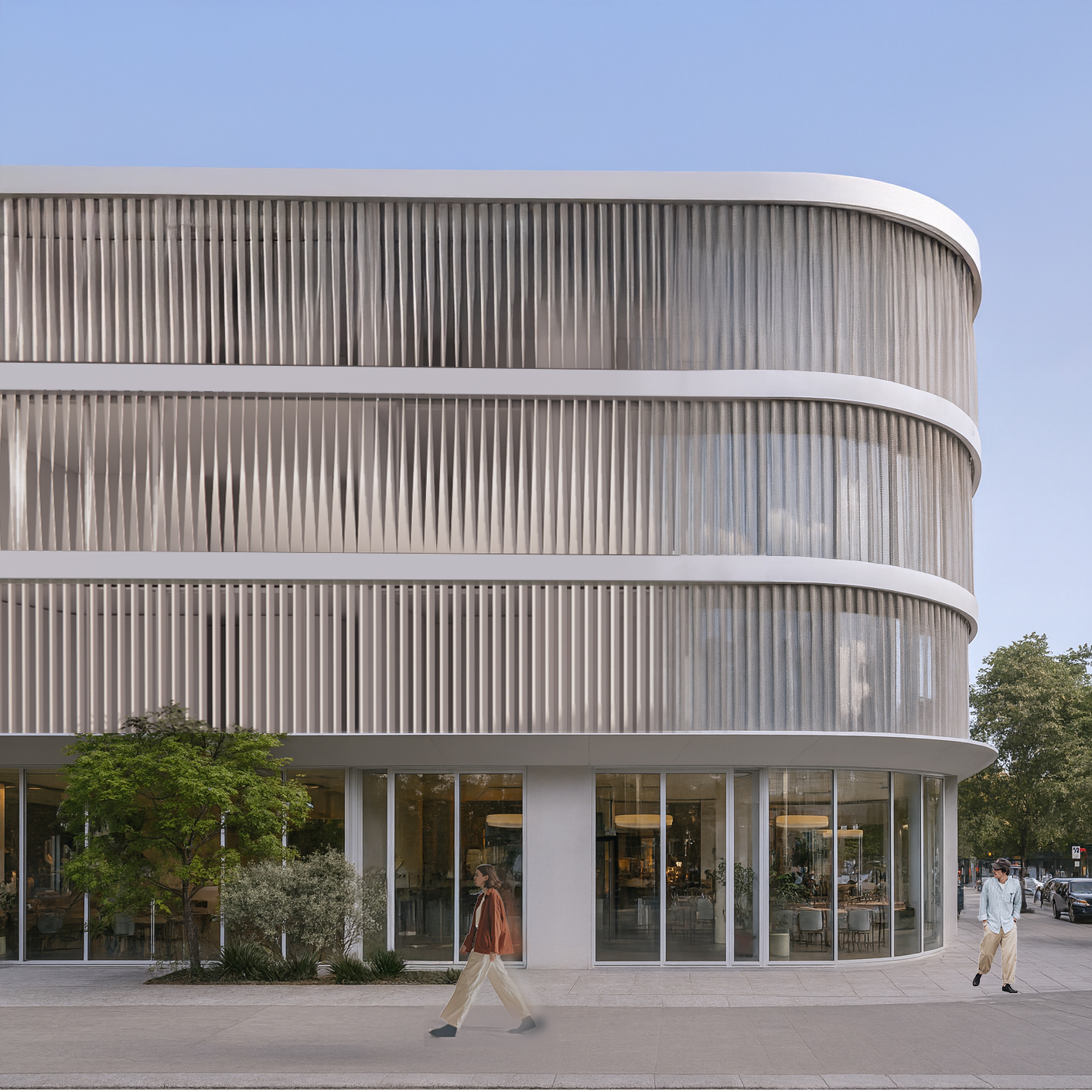
The top and bottom of each vertical fabric fin rotate independently, letting the facade shade through a controlled twist rather than a simple open or closed state.
Work
Kinetic twist-fin facade developed through parametric simulation to compare solar control, useful daylight, and outside view.
Stage
The kinetic facade uses twist-controlled vertical fabric fins to reduce direct sun while preserving useful daylight and outside view. The proposal includes the exterior system, interior comfort, app-based control, and a modular cassette assembly.
The top and bottom of each vertical fabric fin rotate independently, letting the facade shade through a controlled twist rather than a simple open or closed state.
The system aims to reduce direct beam radiation while keeping useful daylight and outside view available.
Head and sill boxes hold the mechanism in a modular bay, with service access and optional BIPV included in the assembly.
The competition proposal developed into a conference-paper study of adaptive solar control, daylight, and view.
Backstage
I used parametric modeling and simulation to compare seasonal poses through direct sun on glazing, Useful Daylight Illuminance, and Horizontal Sight Angle, with fixed and unshaded cases as baselines.
Controlling the two edges independently created a twist gradient, so the upper and lower parts of the opening could respond differently to sun and view.
I compared direct sun, useful daylight, and Horizontal Sight Angle at the same time instead of maximizing one and ignoring the others.
The summer positions block the beam path while keeping a view corridor. The winter positions open for low-angle solar gain.
The current work supports the environmental and geometric logic, but not full engineering validation. Wind, motor sizing, maintenance, and exact control hardware remain outside the confirmed scope.